Customer Requirements
Case Study
Automotive Case Study 01 / 20EV Battery Tray Machining Case Study
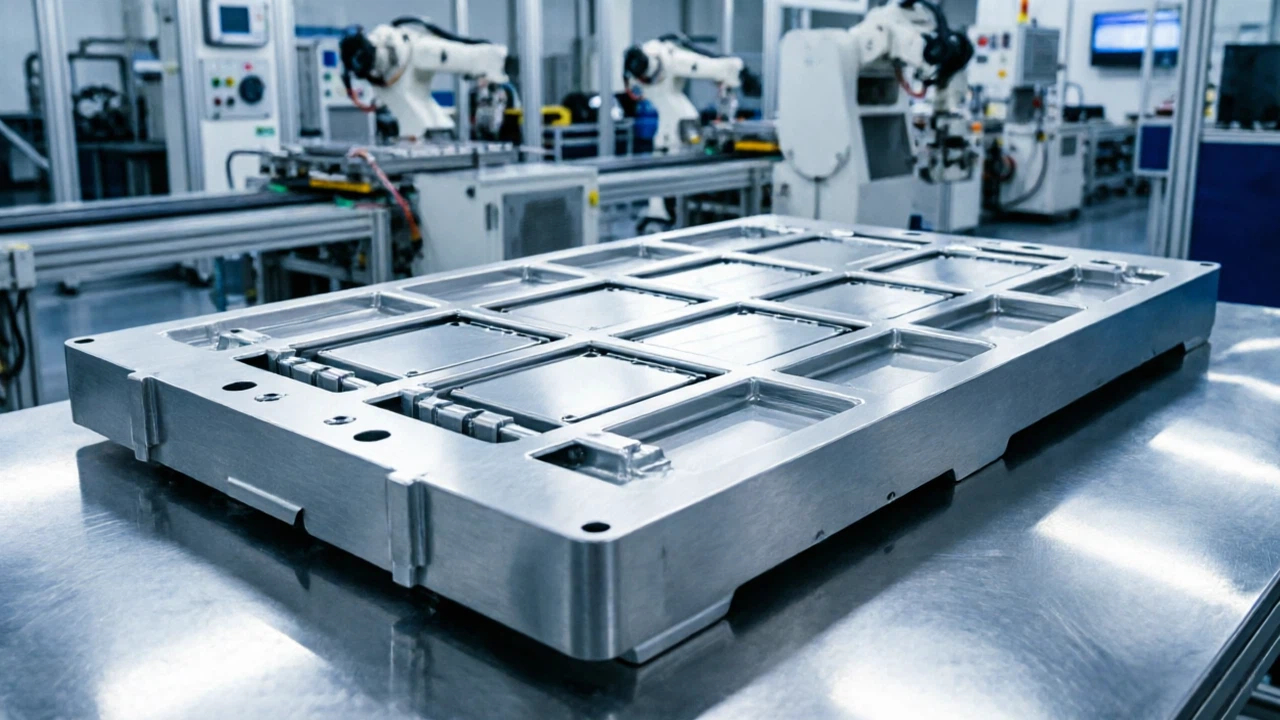
The EV battery tray is one of the most important structural components in modern electric vehicles. It serves as the foundation of the battery pack, supporting battery modules, cooling systems, high-voltage electrical co...
Project Overview
Standard case data fields.
Challenges
Machining difficulty
HYR CNC Solution
Machine configuration
Machining Process
Timeline from raw material to inspection.
Full Case Article
Machining background, difficulty and solution logic.
Quick Facts
Introduction
The EV battery tray is one of the most important structural components in modern electric vehicles. It serves as the foundation of the battery pack, supporting battery modules, cooling systems, high-voltage electrical components, and structural reinforcements.
As electric vehicles become lighter and more energy efficient, battery trays are increasingly manufactured from aluminum alloys such as 6061, 6082, and 6005A. However, extrusion tolerances, welding distortion, and casting variations make it impossible to achieve final dimensional requirements through forming processes alone.
Critical features including sealing surfaces, module mounting faces, cooling plate interfaces, and locating holes require high-precision CNC machining to guarantee assembly accuracy and waterproof performance.
Customer Background
Our customer is a manufacturer of battery pack systems for electric passenger vehicles.
Their battery tray design consisted of:
The customer faced several manufacturing issues:
The goal was to improve machining consistency while maintaining lightweight design and IP67 waterproof performance.
Industry Background
Battery trays have evolved rapidly over the past decade.
Traditional steel trays are gradually being replaced by aluminum solutions because aluminum offers:
Modern EV battery trays are no longer simple structural parts.
They integrate:
As a result, CNC machining plays a critical role in ensuring assembly precision and long-term reliability.
Aluminum 6061-T6
6061 is one of the most widely used materials in battery tray manufacturing.
Advantages:
Applications:
Aluminum 6082-T6
6082 provides higher strength than 6061.
Advantages:
Applications:
Aluminum 6005A
6005A is commonly used for extruded battery tray profiles.
Advantages:
Applications:
Manufacturing Process
The manufacturing process of an EV battery tray generally includes:
Among these steps, CNC machining is the most critical stage because it determines the final dimensional accuracy and sealing performance.
Why CNC Machining Is Necessary
Extrusion and welding processes cannot satisfy the strict tolerances required by EV battery packs.
For example:
Welding Distortion
Large aluminum structures often deform during welding.
Without CNC machining:
Extrusion Tolerance
Extruded aluminum profiles usually have profile deviations.
The following surfaces require precision machining:
Waterproof Requirements
Modern battery trays usually require:
The flatness of sealing surfaces directly affects waterproof performance.
CNC machining is the only economical and reliable method to achieve these requirements.
1. Large Thin-Wall Structure
Battery trays are typically:
During machining:
Controlling deformation is one of the biggest challenges.
2. Sealing Surface Flatness
Battery trays require:
Typical requirement:
If flatness is out of tolerance:
may occur.
3. Hole Position Accuracy
Battery trays contain hundreds of holes.
Including:
Typical requirement:
Position accuracy:
Poor hole accuracy can cause:
HYR CNC Solution
To solve these challenges, HYR recommended the VMC1165 Vertical Machining Center.
Large Machining Travel
VMC1165 provides:
Large enough for:
High Rigidity Structure
The machine adopts:
Benefits:
High-Speed Spindle
Spindle speed:
Advantages:
Especially suitable for:
Automatic Tool Changer
24-tool ATC system.
Supports:
Reducing setup time and improving productivity.
Machining Process
The battery tray machining process includes:
Step 1
Remove excess material while maintaining structural stability.
Step 2
Release internal stress generated by welding.
Reduce deformation in finishing operations.
Step 3
Machine:
Leave finishing allowance.
Step 4
Machine:
Achieve final dimensions.
Step 5
Operations include:
Ensure precise hole position.
Step 6
Remove burrs and sharp edges.
Improve assembly safety.
Step 7
Perform:
Guarantee product quality.
Cutting Parameters
Typical cutting parameters:
These parameters provide a balance between productivity and machining quality.
Quality Inspection
Every battery tray undergoes strict quality inspection.
Inspection includes:
Flatness Measurement
Critical sealing surfaces:
Requirement:
Hole Position Inspection
Check:
Tolerance:
Surface Roughness
Surface finish:
Ensures:
CMM Inspection
Three-dimensional coordinate measurement verifies:
Guaranteeing complete dimensional accuracy.
Results
After implementing HYR CNC solutions:
The customer achieved:
Recommended Machines
For EV battery tray manufacturing, HYR recommends:
HYR VMC850
Suitable for:
HYR VMC1060
Suitable for:
HYR VMC1165
Ideal for:
Conclusion
As EV battery packs become larger, lighter, and more integrated, CNC machining plays an increasingly important role in battery tray manufacturing.
From sealing surfaces and cooling interfaces to module mounting holes and structural features, machining precision directly affects battery safety, waterproof performance, and assembly quality.
With high rigidity, excellent aluminum machining capability, and stable accuracy, HYR CNC machining centers provide an efficient and reliable solution for modern EV battery tray manufacturing.
HYR CNC continues to support manufacturers worldwide with advanced machining technology and customized solutions for the electric vehicle industry.
Results
Before and after machining improvement.
| Item | Before | After |
|---|---|---|
| Result 1 | Before optimization | After implementing HYR CNC solutions: |
| Result 2 | Before optimization | Item |
| Result 3 | Before optimization | Before |
FAQ
Common buyer questions for this case.
What is this case about?
This article covers ev battery tray machining requirements, challenges, process planning and CNC machine selection.
Which machine is recommended?
The final machine should be selected according to part size, material, tolerance, cycle time and fixture plan.
Can HYR-CNC support similar parts?
Yes. Send drawings, material, tolerance and volume so HYR-CNC can recommend a suitable machining proposal.
Recommended Machines
Similar Case Studies
More Automotive machining proof.
Battery Enclosure Machining Case Study
The EV battery enclosure is the outer protective structure of a battery pack. It is designed to protect battery modules, cooling systems, high-voltage electrical components, and wiring harnesses from mechanical shock, du...
Cooling Plate Machining Case Study
Battery thermal management is one of the most critical technologies in modern electric vehicles. As battery energy density continues to increase, maintaining a stable operating temperature has become essential for safety...
Motor Housing Machining Case Study
The electric motor housing is one of the most important structural components in an electric drive system. It supports the rotor and stator assembly, protects internal components, dissipates heat, and provides installati...
Request Quote
Need a similar CNC machining solution?
Send your drawing, material, tolerance, surface finish and production volume. HYR-CNC will recommend the right machine configuration and machining proposal.
Start Machine SelectionRelated Links