Customer Requirements
Case Study
Automotive Case Study 03 / 20Cooling Plate Machining Case Study
Battery thermal management is one of the most critical technologies in modern electric vehicles. As battery energy density continues to increase, maintaining a stable operating temperature has become essential for safety...
Project Overview
Standard case data fields.
Challenges
Machining difficulty
HYR CNC Solution
Machine configuration
Machining Process
Timeline from raw material to inspection.
Full Case Article
Machining background, difficulty and solution logic.
Quick Facts
Introduction
Battery thermal management is one of the most critical technologies in modern electric vehicles. As battery energy density continues to increase, maintaining a stable operating temperature has become essential for safety, charging performance, cycle life, and driving range.
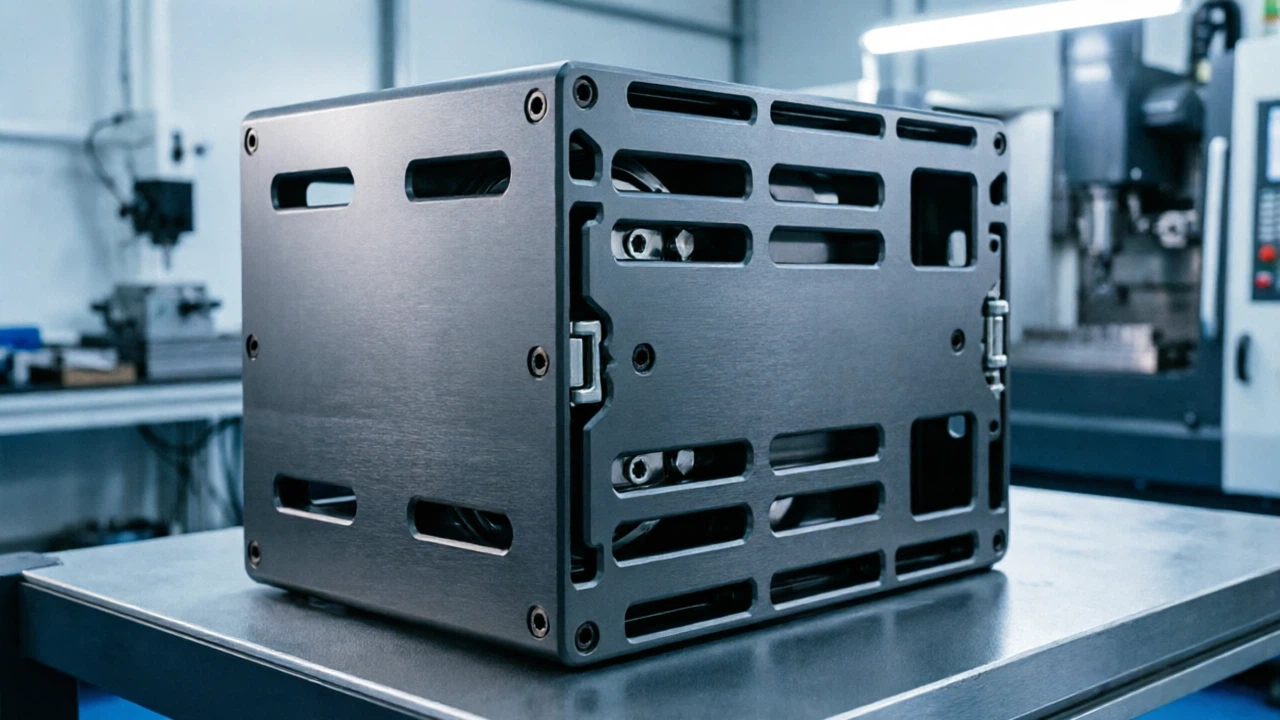
The cooling plate is the core component of the battery cooling system. It is installed beneath or between battery modules and circulates coolant through internal channels to dissipate heat efficiently.
Unlike ordinary aluminum plates, EV cooling plates contain intricate internal flow channels, multiple sealing surfaces, and dozens of inlet and outlet interfaces. These features require extremely high dimensional accuracy and surface quality.
Although extrusion and welding technologies can create the basic structure, CNC machining is essential for producing sealing faces, fluid ports, module interfaces, and precision locating features.
Customer Background
The customer is a supplier of battery thermal management systems for electric passenger vehicles.
Their cooling plate products are used in:
The customer's original manufacturing process faced several issues:
HYR CNC proposed a dedicated aluminum machining solution to improve surface quality, sealing performance, and machining efficiency.
Industry Background
Battery cooling systems are evolving rapidly.
Early electric vehicles relied primarily on:
However, as battery capacity increased, these methods became insufficient.
Today, liquid cooling systems dominate the market because they provide:
As a result, cooling plates have become increasingly complex.
Modern cooling plates often integrate:
The increasing complexity directly increases the demand for high-precision CNC machining.
Aluminum 3003
3003 is commonly used in brazed cooling plates.
Advantages:
Applications:
Aluminum 6061
6061 provides:
Applications:
Aluminum 6063
6063 is widely used in extrusion cooling plates.
Advantages:
Applications:
Manufacturing Process
The manufacturing process of EV cooling plates typically includes:
Among all these processes, CNC machining determines the sealing performance and assembly accuracy.
Why CNC Machining Is Necessary
The cooling plate is not simply a heat exchanger.
It is also:
Its critical features require precision machining.
Sealing Surfaces
Cooling plates operate under coolant pressure.
The sealing faces require:
If the sealing surface is uneven:
Fluid Interfaces
Cooling plates contain:
These features require:
Small errors may cause:
Internal Flow Channels
The internal channels must maintain:
CNC machining ensures these requirements are met consistently.
1. Thin-Wall Deformation
Cooling plates are usually:
Typical wall thickness:
During machining:
Controlling deformation is extremely challenging.
2. Surface Finish
The coolant sealing surfaces require:
Poor surface finish causes:
Achieving stable surface quality requires:
3. Leakage Prevention
One of the most important requirements is:
Zero leakage.
Any machining defect may lead to:
Therefore:
must all be tightly controlled.
HYR CNC Solution
HYR recommended the VMC850 Vertical Machining Center.
High-Speed Aluminum Machining
The spindle speed reaches:
Advantages:
Suitable for:
High Rigidity Structure
The machine adopts:
Benefits:
Automatic Tool Changer
24-tool ATC.
Supports:
Improving efficiency and reducing setup time.
High Pressure Coolant
Benefits:
Especially suitable for:
Step 1
Machine:
Remove excess material.
Step 2
Release residual stress.
Reduce deformation.
Step 3
Machine:
Leave finishing allowance.
Step 4
Machine:
Achieve final accuracy.
Step 5
Operations:
Step 6
Remove:
Improve assembly safety.
Step 7
Test:
Ensure zero leakage.
Cutting Parameters
Typical cutting parameters:
Quality Inspection
Each cooling plate undergoes strict inspection.
Flatness Inspection
Requirement:
Inspect:
Surface Roughness
Requirement:
Ensures:
Hole Position Inspection
Requirement:
Inspect:
Pressure Test
Cooling plates are tested under coolant pressure.
Inspect:
Guaranteeing safe operation.
Results
After adopting HYR CNC machining solutions:
The customer achieved:
HYR VMC850
Recommended for:
HYR VMC1060
Suitable for:
HYR VMC1165
Ideal for:
Related Articles
What Is CNC Milling?
What materials are used for EV cooling plates?
Common materials include aluminum 3003, 6061 and 6063 due to their excellent thermal conductivity and corrosion resistance.
Why is CNC machining necessary for cooling plates?
CNC machining ensures sealing surface flatness, hole position accuracy and leak-free fluid interfaces.
What surface finish is required?
Most cooling plates require Ra0.8 or better on sealing surfaces.
What flatness is required?
Typical flatness requirements are 0.03 mm or better.
Which CNC machine is recommended?
High-speed machining centers such as the HYR VMC850 are ideal for aluminum cooling plate manufacturing.
Conclusion
As electric vehicles demand higher battery performance and improved thermal management, cooling plates are becoming increasingly sophisticated and precise.
From internal flow channels to sealing surfaces and fluid interfaces, every critical feature depends on high-quality CNC machining.
With excellent aluminum machining capability, high spindle speed, and stable accuracy, HYR CNC machining centers provide reliable and efficient solutions for EV cooling plate manufacturing.
HYR CNC continues to support global battery manufacturers with advanced machining technology and customized production solutions.
Results
Before and after machining improvement.
| Item | Before | After |
|---|---|---|
| Result 1 | Before optimization | After adopting HYR CNC machining solutions: |
| Result 2 | Before optimization | Item |
| Result 3 | Before optimization | Before |
FAQ
Common buyer questions for this case.
What is this case about?
This article covers ev cooling plate machining requirements, challenges, process planning and CNC machine selection.
Which machine is recommended?
The final machine should be selected according to part size, material, tolerance, cycle time and fixture plan.
Can HYR-CNC support similar parts?
Yes. Send drawings, material, tolerance and volume so HYR-CNC can recommend a suitable machining proposal.
Recommended Machines
Similar Case Studies
More Automotive machining proof.
EV Battery Tray Machining Case Study
The EV battery tray is one of the most important structural components in modern electric vehicles. It serves as the foundation of the battery pack, supporting battery modules, cooling systems, high-voltage electrical co...
Battery Enclosure Machining Case Study
The EV battery enclosure is the outer protective structure of a battery pack. It is designed to protect battery modules, cooling systems, high-voltage electrical components, and wiring harnesses from mechanical shock, du...
Motor Housing Machining Case Study
The electric motor housing is one of the most important structural components in an electric drive system. It supports the rotor and stator assembly, protects internal components, dissipates heat, and provides installati...
Request Quote
Need a similar CNC machining solution?
Send your drawing, material, tolerance, surface finish and production volume. HYR-CNC will recommend the right machine configuration and machining proposal.
Start Machine SelectionRelated Links